The gentle giant, by design
Breed standards ask for a friendly, confident dog that is never timid or aggressive. Getting there is up to breeding, socialisation and training, and with a dog this big, good manners matter more than for most breeds.
The AKC minimum for a dog is 76 cm (30 in); taller is preferred.[2]
What “gentle giant” means
- A large genetic study of more than 18,000 dogs found that breed explained only about 9% of the behavioural differences between individual dogs.[36]
- So the standards tell you what breeders aim for, not what your dog will be. Genetics, early rearing, socialisation and training all shape the adult dog.[36,32]
- Temperament may even matter for health: in a prospective study of large and giant breeds including Great Danes, dogs their owners described as happy had a lower incidence of bloat. This is an association only, not proof of cause.[38]
What breed clubs say is typical
- Breed clubs describe a gentle, loving family companion whose main asset in training is a wish to please.[6,7]
- Adults are generally calm and not especially active; their exercise needs are moderate.[10,7]
- Clubs also warn that Danes can be aloof or stubborn, though perfectly trainable, and that some need a little more motivation.[7,9]
- They descend from a hunting breed and some have a strong prey drive, so early, calm exposure to cats and small animals matters.[8,9,7]
- Danes are house dogs. Clubs advise raising them indoors as part of the family, not as yard dogs, though a fenced yard is still needed.[6,8]
Living with the size
- Many Danes lean their weight against people. Greencross Vets says Danes are known for it, to get attention and affection or to show they feel safe.[11]
- Leaning is usually friendly, but a leaning or bumping Dane can easily knock over a child or an older person. Teach a reliable 'sit' or 'settle' for greetings.[9,10]
- Secure your dog with a crash-tested harness attached to a seat belt, or a secured crate big enough to stand with head upright, turn around and lie down comfortably. For an adult Dane, that is a very large crate.[25,6]
- A cargo barrier protects the people in the car but not the dog, so add a harness. Rules differ between states, so check your state's road rules.[25]
- Never leave a dog alone in a car. Heat stress can kill quickly, even in mild weather.[25]
Alert, not aggressive
- Fear is the most common cause of aggression in dogs. Pain and illness can also play a part, so see your vet first.[15,23,24]
- Don't punish growling. A dog punished for warning may stop warning and bite 'without warning' later.[24]
- Avoid confrontational or pain-based methods (choke, prong or shock collars, physical corrections). They are linked to more aggression and anxiety, not less.[14,23]
- For fear, anxiety or aggression, ask your vet for a referral to a veterinary behaviourist, or a credentialed behaviour consultant who uses reward-based methods.[16,23,17]
In Australia, the ANZCVS Veterinary Behaviour Chapter keeps a list of behaviour veterinarians.[17] Your own vet can refer you.
Healthy watchfulness
What the breed should look like.
- Alert and watchful, yet friendly and outgoing with people in everyday life.[1,10]
- Welcomes visitors happily unless it suspects an intruder.[11,10]
- May be reserved with strangers, but is confident, easy to handle and slow to take offence.[3]
- Never timid, never aggressive.[2,5]
Australian breed profiles describe a dog that welcomes visitors happily but will guard its family against intruders.[10,11]
Signs of fear or over-guarding
From the quietest signals to a bite. The earlier you notice, the easier it is to help. Any of these is a reason to get help.
Early stress signals such as yawning, lip-licking, looking or turning away, ears back, crouching or a tucked tail.[24,14]
Stronger warnings: bared teeth, narrowed eyes, raised hackles, growling, snarling, barking or snapping.[24,23]
Guarding food, toys, resting places or territory from family members or guests.[24]
Mouthing and bite inhibition
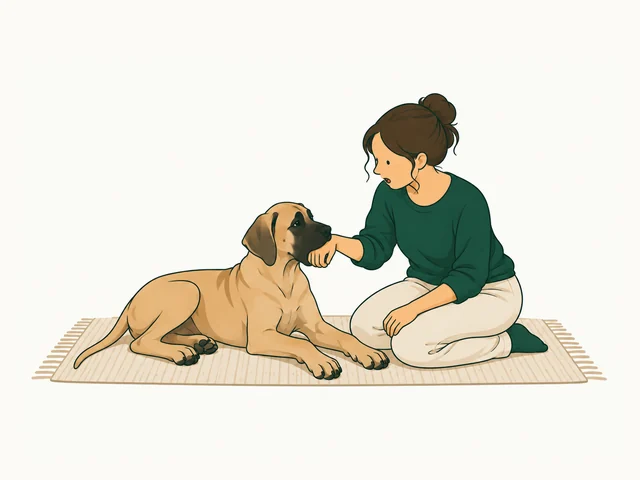
Step 1 of 5
Soften the pressure first
During gentle play, respond to a hard bite with a sharp yelp and let your hand go limp. Praise and resume when your puppy backs off. Don't overdo it: the ASPCA suggests yelping no more than three times in 15 minutes.[30]
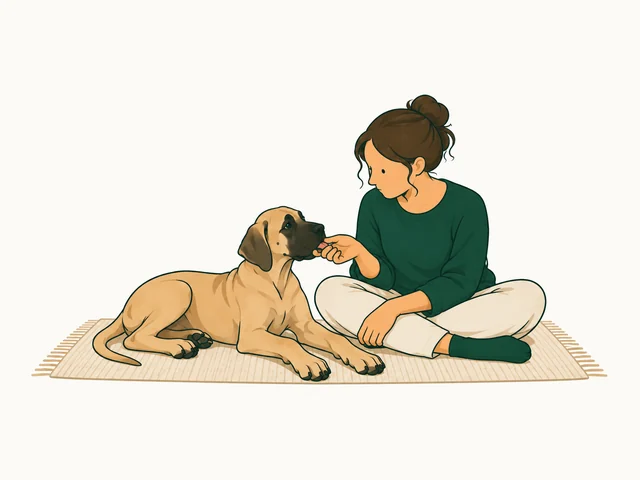
Step 2 of 5
Then raise the bar
Once hard bites stop, respond to moderate bites the same way, until your puppy is using almost no pressure at all.[30]
Avoid, and know when to get help
- Don't slap, tap the nose or scruff-shake. Physical punishment can make puppies bite harder.[30,27]
- Don't whip your hand away. It turns your hand into a chase toy.[30]
- Skip aversive tools and 'alpha' methods entirely; reward-based training is recommended by veterinary behaviourists and the RSPCA.[14,21]
Socialisation, week by week
Training priorities
Everyday life
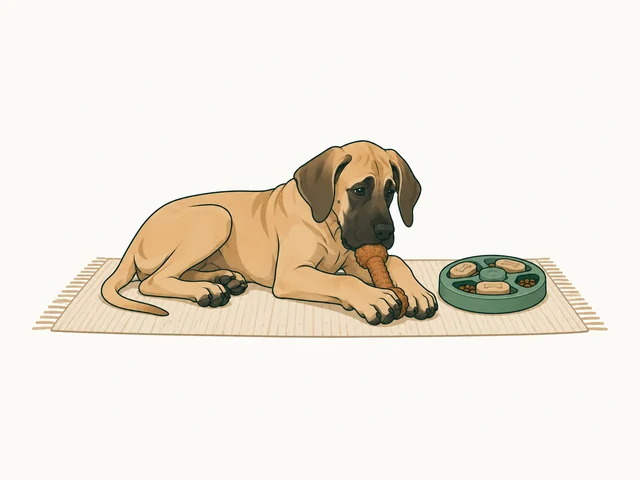
- Enrichment lets dogs use natural behaviours, lowers stress and improves behaviour.[26]
- Mix it up: training games, sniffing walks and new places, puzzle feeders and food toys, snuffle mats and new scents, and time with people and friendly dogs.[26]
- Rotate toys so they stay interesting, count food rewards in the daily ration, and check toys for pieces that could be swallowed.[26]
- Danes need human company. Left alone and forgotten, they can become destructive or anxious.[8,11]
- The RSPCA in England and Wales advises leaving dogs alone for no longer than four hours. Build up to it in small steps, starting with short absences in puppyhood.[29,11]
- Keep departures and returns low-key, and give a long-lasting chew as you leave.[28]
- Signs of distress include barking, howling, toileting indoors, destruction, scratching at doors or escape attempts. Quieter signs are pacing, trembling and whining, so record your dog while you're out.[28,29]
- If you see these signs, talk to your vet. A veterinary behaviourist can create a plan and, if needed, prescribe medication alongside training.[28,17]
- Look for reward-based methods (treats, toys, praise, markers such as a clicker) and a trainer who welcomes questions.[16,21]
- Red flags include talk of being 'alpha' or 'pack leader', lead jerks, and prong or shock collars.[16,14]
- Watch your dog: if it looks stressed or afraid during training, speak up or find another trainer.[16]