What the standard asks for
A breed standard is a written picture of the ideal Great Dane: a giant, balanced dog with strength, elegance and a noble head. The AKC, FCI and Dogs Australia each keep their own, and they differ in size, colours and faults.
- 80–90 cm
- the FCI's height range for dogs, the only one of the three with an upper limit[2]
Three standards, side by side
- In Australia, Great Danes are judged and registered under the Dogs Australia (Australian National Kennel Council, ANKC) standard. The Great Dane Club of Victoria, for example, breeds to the ANKC standard and code of ethics, and Dogs Victoria links to the Dogs Australia standard.[4,3,6]
- The Australian standard is not the FCI one. Comparing the texts ourselves, much of its wording and all its size figures match the UK Kennel Club standard: the same 76 cm and 71 cm minimum heights, 54 kg and 46 kg minimum weights, and the same 'dash and daring' description. We found no source saying Dogs Australia adopted the UK text.[3,7,6]
- We could not open the Dogs Australia website to confirm the current version date, so the Australian column uses the text reproduced by the Great Dane Club of Victoria and Dogs Victoria. Check with Dogs Australia or your state body before relying on a detail for showing or breeding.[3,6]
Current version
General appearance
Dogs Australia
Very muscular, strongly yet elegantly built, with a look of 'dash and daring'. Elegance of outline and grace of form are essential.[3]
AKC
Dignity, strength and elegance with great size and a powerful, smoothly muscled body. Lack of true breed type is the most serious fault.[1]
FCI
A large, powerful, well-built body combined with pride, strength and elegance; the standard calls it the 'Apollo' of breeds. Sexes should be clearly distinct.[2]
Height at withers
Dogs Australia
Adults over 18 months. Dogs: at least 76 cm (30 in). Bitches: at least 71 cm (28 in). No upper limit.[3,6]
AKC
Dogs: at least 76 cm (30 in), 81 cm (32 in) or more preferred. Bitches: at least 71 cm (28 in), 76 cm (30 in) or more preferred.[1]
FCI
Dogs: at least 80 cm, should not exceed 90 cm. Bitches: at least 72 cm, should not exceed 84 cm.[2]
Weight
Proportions
Head
Dogs Australia
Gives an impression of great length and strength of jaw. Broad muzzle, proportionately narrow skull, so the head looks equally wide throughout. Decided brow, but no abrupt stop.[3]
AKC
Rectangular, long and finely chiselled. Skull and muzzle planes parallel; pronounced stop; nose-to-stop equals stop-to-occiput. Nose bridge as broad as possible.[1]
FCI
Long, narrow and expressive, never wedge-shaped. Muzzle and skull 1:1 with parallel planes; clearly defined stop; broad nasal bridge.[2]
Eyes & ears
Dogs Australia
Medium, fairly deep-set eyes, preferably dark; odd or wall eyes acceptable in harlequins. Ears triangular, medium, set high and folded forward.[3]
AKC
Medium, deep-set, dark eyes with almond-shaped lids; blue or odd eyes allowed in harlequins and merles. Ears high set and folded forward; if cropped, carried evenly erect.[1]
FCI
Medium, almond-shaped eyes, as dark as possible; ice-blue or odd eyes tolerated in harlequins (white or grey with black patches). Ears naturally hanging, set high.[2]
Neck
Forequarters
Dogs Australia
Muscular, well-sloped shoulders that are not loaded; elbows well under the body; forelegs perfectly straight with big, flat bone.[3]
AKC
Sloping shoulder blade meeting the upper arm as close to a right angle (90°) as possible; blade and upper arm equal length. Elbow halfway from withers to ground. Pasterns slope slightly.[1]
FCI
Long, slanting shoulder blade at 100–110° to the upper arm, which is slightly longer than the blade. Forearm straight and vertical; pasterns barely slope.[2]
Hindquarters & angulation
Dogs Australia
Extremely muscular for strength and galloping power; long second thigh, good turn of stifle, hocks set low and turning neither in nor out.[3]
AKC
Strong, broad and muscular, well angulated, with well let-down hocks that look straight from behind.[1]
FCI
Well angulated, with long, broad thighs; stifle almost directly below the hip; lower thigh about as long as the thigh; short, near-vertical rear pastern. Too much or too little angulation is a fault.[2]
Gait
Dogs Australia
Lithe, springy and free, covering ground well; hocks drive freely; head carried high.[3]
AKC
Long, easy strides with no tossing, rolling or bouncing; level backline; reach balanced by rear drive. Legs converge towards the centre line at speed.[1]
FCI
Harmonious, lithe, ground-covering and slightly springy; never short-strided or pacing. Constant pacing is a severe fault.[2]
Coat
Colours
Dogs Australia
Brindle, fawn, blue, black, mantle and harlequin. Merle is not described. White only on chest and feet, and undesirable even there.[3]
AKC
Seven: brindle, fawn, blue, black, harlequin, mantle and merle.[1]
FCI
Bred in three separate varieties: fawn and brindle; harlequin, merle and black (including mantle); blue.[2]
Temperament
Disqualifications & serious faults
Dogs Australia
No disqualification list. Any departure from the standard is a fault, weighted by its degree. Males need two apparently normal, fully descended testicles.[3]
AKC
Disqualified: under minimum height, split nose, docked tail, any colour outside the seven, merlequin. Very serious: haws, undershot or wry mouth.[1]
FCI
Disqualified (selection): aggression or excessive shyness, blindness or deafness, entropion or ectropion, faulty bites, kinked tail, wrong colours (including all-white harlequins), under minimum height. Severe: nervousness, heavy wrinkles or dewlap, sway or roach back.[2]
| Aspect | American Kennel ClubUSA | FCI No. 235, Deutsche DoggeGermany & FCI countries | Dogs Australia (ANKC)Australia · applies here |
|---|---|---|---|
| Current version | Approved 9 July 2018, in force from 1 January 2019.[1] | Valid from 21 August 2024. Country of origin: Germany. Kept by the German breed club.[2] | Version date not confirmed. Much of the wording matches the UK Kennel Club standard (last updated July 2008).[3,7] |
| General appearance | Dignity, strength and elegance with great size and a powerful, smoothly muscled body. Lack of true breed type is the most serious fault.[1] | A large, powerful, well-built body combined with pride, strength and elegance; the standard calls it the 'Apollo' of breeds. Sexes should be clearly distinct.[2] | Very muscular, strongly yet elegantly built, with a look of 'dash and daring'. Elegance of outline and grace of form are essential.[3] |
| Height at withers | Dogs: at least 76 cm (30 in), 81 cm (32 in) or more preferred. Bitches: at least 71 cm (28 in), 76 cm (30 in) or more preferred.[1] | Dogs: at least 80 cm, should not exceed 90 cm. Bitches: at least 72 cm, should not exceed 84 cm.[2] | Adults over 18 months. Dogs: at least 76 cm (30 in). Bitches: at least 71 cm (28 in). No upper limit.[3,6] |
| Weight | No weight given. Dogs should look more massive, with larger frames and heavier bone.[1] | No weight given.[2] | Adults over 18 months. Dogs: at least 54 kg (120 lb). Bitches: at least 46 kg (100 lb).[3,6,7] |
| Proportions | Square: body length about equal to height. Bitches may be a little longer in body if well proportioned.[1] | Nearly square, especially dogs. Bitches may be slightly longer.[2] | No body ratio given. Head length should be in proportion to the dog's height.[3] |
| Head | Rectangular, long and finely chiselled. Skull and muzzle planes parallel; pronounced stop; nose-to-stop equals stop-to-occiput. Nose bridge as broad as possible.[1] | Long, narrow and expressive, never wedge-shaped. Muzzle and skull 1:1 with parallel planes; clearly defined stop; broad nasal bridge.[2] | Gives an impression of great length and strength of jaw. Broad muzzle, proportionately narrow skull, so the head looks equally wide throughout. Decided brow, but no abrupt stop.[3] |
| Eyes & ears | Medium, deep-set, dark eyes with almond-shaped lids; blue or odd eyes allowed in harlequins and merles. Ears high set and folded forward; if cropped, carried evenly erect.[1] | Medium, almond-shaped eyes, as dark as possible; ice-blue or odd eyes tolerated in harlequins (white or grey with black patches). Ears naturally hanging, set high.[2] | Medium, fairly deep-set eyes, preferably dark; odd or wall eyes acceptable in harlequins. Ears triangular, medium, set high and folded forward.[3] |
| Neck | Firm, high set, well arched, long and muscular, broadening into the withers, with a clean throat.[1] | Long, clean and muscular, never short or thick; arched and carried upright, slightly forward.[2] | Long, arched and clean, well set into the shoulders.[3] |
| Forequarters | Sloping shoulder blade meeting the upper arm as close to a right angle (90°) as possible; blade and upper arm equal length. Elbow halfway from withers to ground. Pasterns slope slightly.[1] | Long, slanting shoulder blade at 100–110° to the upper arm, which is slightly longer than the blade. Forearm straight and vertical; pasterns barely slope.[2] | Muscular, well-sloped shoulders that are not loaded; elbows well under the body; forelegs perfectly straight with big, flat bone.[3] |
| Hindquarters & angulation | Strong, broad and muscular, well angulated, with well let-down hocks that look straight from behind.[1] | Well angulated, with long, broad thighs; stifle almost directly below the hip; lower thigh about as long as the thigh; short, near-vertical rear pastern. Too much or too little angulation is a fault.[2] | Extremely muscular for strength and galloping power; long second thigh, good turn of stifle, hocks set low and turning neither in nor out.[3] |
| Gait | Long, easy strides with no tossing, rolling or bouncing; level backline; reach balanced by rear drive. Legs converge towards the centre line at speed.[1] | Harmonious, lithe, ground-covering and slightly springy; never short-strided or pacing. Constant pacing is a severe fault.[2] | Lithe, springy and free, covering ground well; hocks drive freely; head carried high.[3] |
| Coat | Short, thick and clean, with a smooth, glossy look.[1] | Very short, dense, smooth, close-lying and glossy; never coarse, dull or double-coated.[2] | Short, dense and sleek, never inclined to roughness.[3] |
| Colours | Seven: brindle, fawn, blue, black, harlequin, mantle and merle.[1] | Bred in three separate varieties: fawn and brindle; harlequin, merle and black (including mantle); blue.[2] | Brindle, fawn, blue, black, mantle and harlequin. Merle is not described. White only on chest and feet, and undesirable even there.[3] |
| Temperament | Spirited, courageous, always friendly and dependable; never timid or aggressive.[1] | Friendly, loving and devoted, possibly reserved with strangers. Confident, fearless, easy to train, hard to provoke; never aggressive.[2] | Kindly without nervousness, friendly and outgoing.[3] |
| Disqualifications & serious faults | Disqualified: under minimum height, split nose, docked tail, any colour outside the seven, merlequin. Very serious: haws, undershot or wry mouth.[1] | Disqualified (selection): aggression or excessive shyness, blindness or deafness, entropion or ectropion, faulty bites, kinked tail, wrong colours (including all-white harlequins), under minimum height. Severe: nervousness, heavy wrinkles or dewlap, sway or roach back.[2] | No disqualification list. Any departure from the standard is a fault, weighted by its degree. Males need two apparently normal, fully descended testicles.[3] |
Current version
General appearance
- AKC
- Dignity, strength and elegance with great size and a powerful, smoothly muscled body. Lack of true breed type is the most serious fault.[1]
- FCI
- A large, powerful, well-built body combined with pride, strength and elegance; the standard calls it the 'Apollo' of breeds. Sexes should be clearly distinct.[2]
- Dogs Australia · applies in Australia
- Very muscular, strongly yet elegantly built, with a look of 'dash and daring'. Elegance of outline and grace of form are essential.[3]
Height at withers
Weight
Proportions
Head
- AKC
- Rectangular, long and finely chiselled. Skull and muzzle planes parallel; pronounced stop; nose-to-stop equals stop-to-occiput. Nose bridge as broad as possible.[1]
- FCI
- Long, narrow and expressive, never wedge-shaped. Muzzle and skull 1:1 with parallel planes; clearly defined stop; broad nasal bridge.[2]
- Dogs Australia · applies in Australia
- Gives an impression of great length and strength of jaw. Broad muzzle, proportionately narrow skull, so the head looks equally wide throughout. Decided brow, but no abrupt stop.[3]
Eyes & ears
- AKC
- Medium, deep-set, dark eyes with almond-shaped lids; blue or odd eyes allowed in harlequins and merles. Ears high set and folded forward; if cropped, carried evenly erect.[1]
- FCI
- Medium, almond-shaped eyes, as dark as possible; ice-blue or odd eyes tolerated in harlequins (white or grey with black patches). Ears naturally hanging, set high.[2]
- Dogs Australia · applies in Australia
- Medium, fairly deep-set eyes, preferably dark; odd or wall eyes acceptable in harlequins. Ears triangular, medium, set high and folded forward.[3]
Neck
Forequarters
- AKC
- Sloping shoulder blade meeting the upper arm as close to a right angle (90°) as possible; blade and upper arm equal length. Elbow halfway from withers to ground. Pasterns slope slightly.[1]
- FCI
- Long, slanting shoulder blade at 100–110° to the upper arm, which is slightly longer than the blade. Forearm straight and vertical; pasterns barely slope.[2]
- Dogs Australia · applies in Australia
- Muscular, well-sloped shoulders that are not loaded; elbows well under the body; forelegs perfectly straight with big, flat bone.[3]
Hindquarters & angulation
- AKC
- Strong, broad and muscular, well angulated, with well let-down hocks that look straight from behind.[1]
- FCI
- Well angulated, with long, broad thighs; stifle almost directly below the hip; lower thigh about as long as the thigh; short, near-vertical rear pastern. Too much or too little angulation is a fault.[2]
- Dogs Australia · applies in Australia
- Extremely muscular for strength and galloping power; long second thigh, good turn of stifle, hocks set low and turning neither in nor out.[3]
Gait
- AKC
- Long, easy strides with no tossing, rolling or bouncing; level backline; reach balanced by rear drive. Legs converge towards the centre line at speed.[1]
- FCI
- Harmonious, lithe, ground-covering and slightly springy; never short-strided or pacing. Constant pacing is a severe fault.[2]
- Dogs Australia · applies in Australia
- Lithe, springy and free, covering ground well; hocks drive freely; head carried high.[3]
Coat
Colours
- AKC
- Seven: brindle, fawn, blue, black, harlequin, mantle and merle.[1]
- FCI
- Bred in three separate varieties: fawn and brindle; harlequin, merle and black (including mantle); blue.[2]
- Dogs Australia · applies in Australia
- Brindle, fawn, blue, black, mantle and harlequin. Merle is not described. White only on chest and feet, and undesirable even there.[3]
Temperament
- AKC
- Spirited, courageous, always friendly and dependable; never timid or aggressive.[1]
- FCI
- Friendly, loving and devoted, possibly reserved with strangers. Confident, fearless, easy to train, hard to provoke; never aggressive.[2]
- Dogs Australia · applies in Australia
- Kindly without nervousness, friendly and outgoing.[3]
Disqualifications & serious faults
- AKC
- Disqualified: under minimum height, split nose, docked tail, any colour outside the seven, merlequin. Very serious: haws, undershot or wry mouth.[1]
- FCI
- Disqualified (selection): aggression or excessive shyness, blindness or deafness, entropion or ectropion, faulty bites, kinked tail, wrong colours (including all-white harlequins), under minimum height. Severe: nervousness, heavy wrinkles or dewlap, sway or roach back.[2]
- Dogs Australia · applies in Australia
- No disqualification list. Any departure from the standard is a fault, weighted by its degree. Males need two apparently normal, fully descended testicles.[3]
Seven colours, three rulebooks
- Merle became show-eligible with the AKC on 1 January 2019, after Great Dane Club of America members voted to recognise it in 2015.[8,1]
- The FCI says the breed is bred in three separate colour varieties. It disqualifies all-white harlequins and blues with a white blaze, collar, stockings or tail tip.[2]
- In Australia, the Great Dane Club of Victoria says only six colours can be bred from and shown on the Main Register, and dogs of any other colour go on the Limited Register. The six colours in the Australian standard, and in Dogs Victoria's breed profile, are brindle, fawn, blue, black, mantle and harlequin.[5,3,6]
- The AKC disqualifies 'merlequin', a white dog with only merle patches.[1]
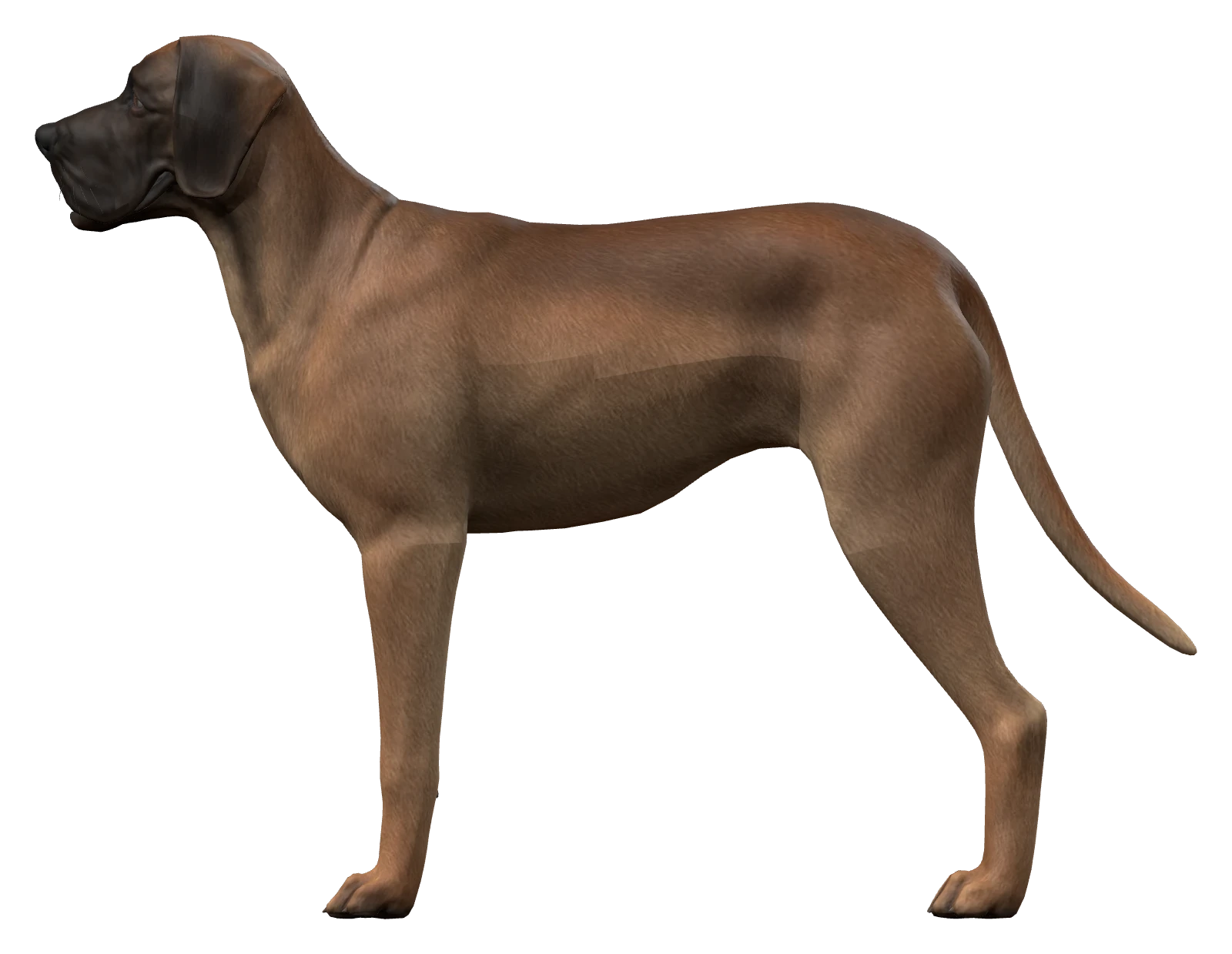
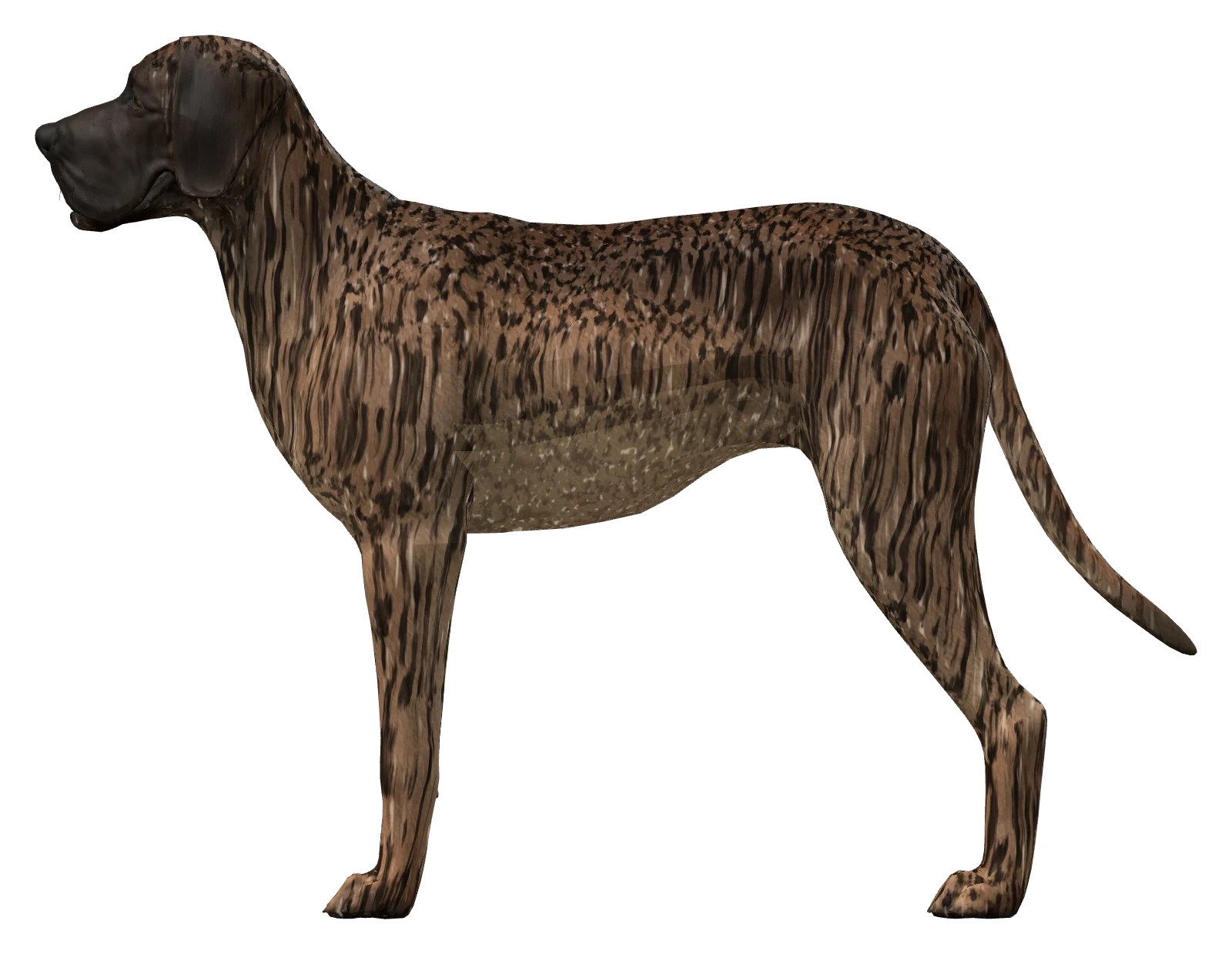
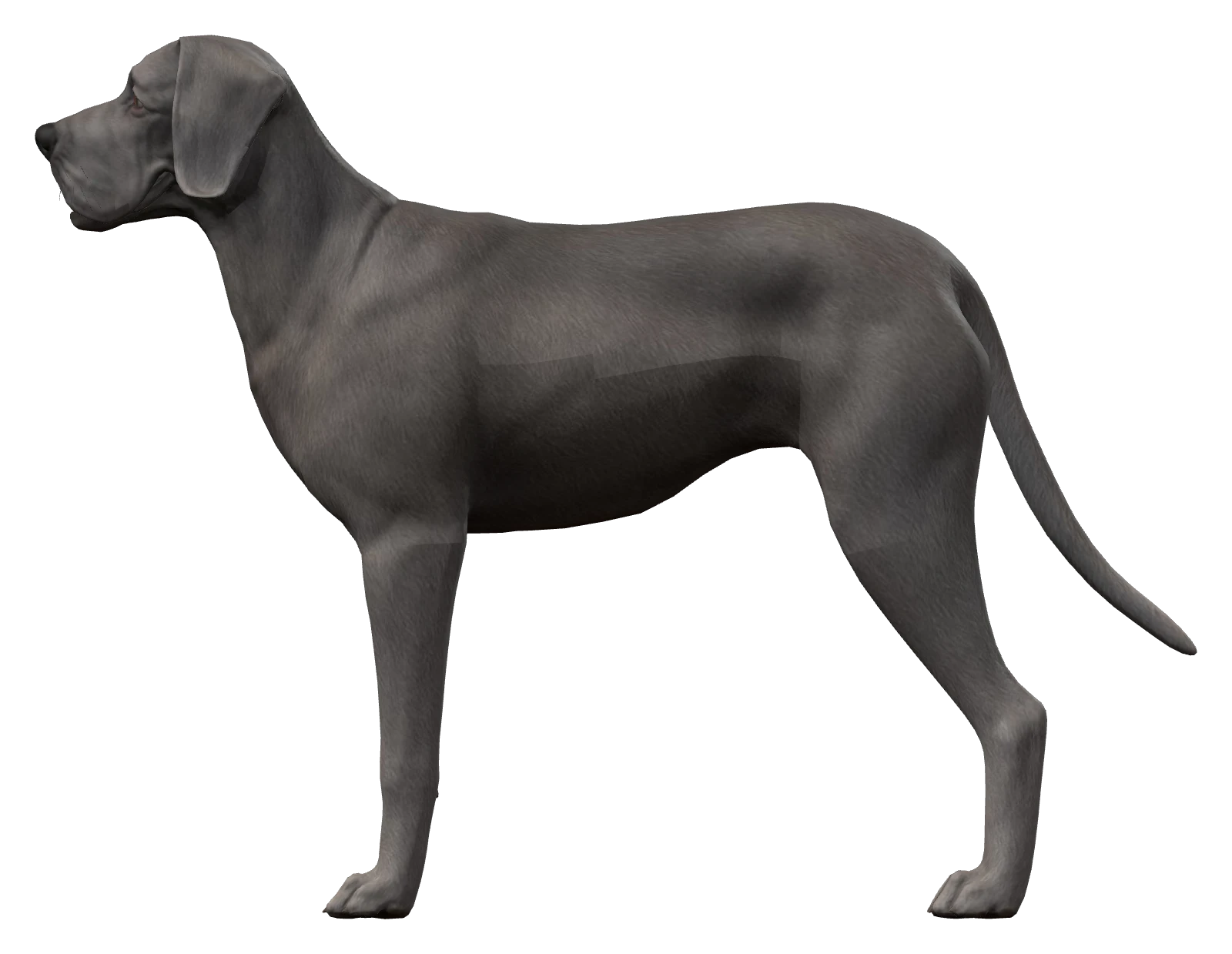
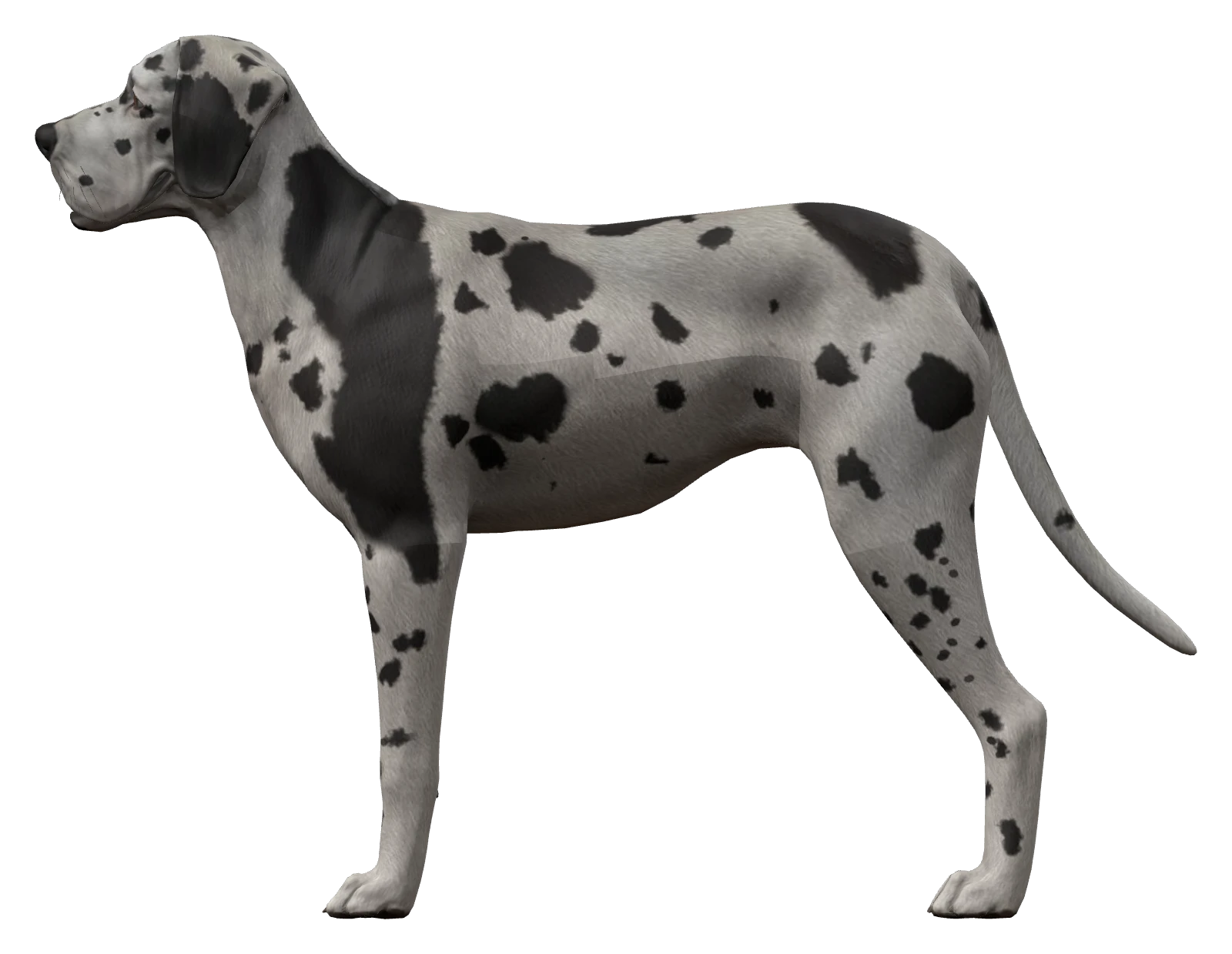
Illustrations are recoloured renders of the site's 3D model, not photographs. Status sources[1,2,3,8,5]
Merle, harlequin and mantle
- Merle comes from a small piece of mobile DNA (a SINE retrotransposon) inserted in the PMEL pigment gene. One copy dilutes parts of a dark coat to grey, leaving patches of full colour.[11]
- The length of the insertion's tail matters. Short versions give 'cryptic' merles that look solid; longer ones give dilute, standard or heavily white merle patterns.[12,13]
- Merle can also be hidden, for example under a fawn coat that shows no grey. A hidden merle still passes merle on, so a merle bred to a dog that looks solid can produce double merle puppies. Dogs can also carry a mix of merle lengths.[14,13]
- Harlequin needs two genes: merle plus one copy of a dominant harlequin variant (H). Together they give black patches on a white background.[15,16]
- H is a single-letter change in PSMB7, a gene for part of the proteasome, the machinery cells use to break down proteins.[16]
- A dog carrying H without merle does not look harlequin, and harlequins almost always produce merle puppies. They do not breed true.[15,8]
- White spotting in dogs is controlled mainly at the S locus, which maps to the MITF gene.[17]
- Mantle looks like 'Irish spotting' with more white running onto the thighs and up the body. In Great Danes, the piebald variant acts in a dose-dependent way: more copies, more white.[18]
- White spotting genetics are complex, and a single S-locus test does not explain every white pattern.[18]
The two pairings to avoid
- A puppy that inherits merle from both parents (MM) is a double merle, often with a lot of white. The nickname 'lethal white' is misleading: double merles do survive, but with a much higher risk of deafness and eye defects.[11,20,19]
- In a hearing study of 153 merle dogs, 25% of double merles were deaf (10% in one ear, 15% in both), compared with 3.6% of single merles (2.7% one ear, 0.9% both).[19]
- In a study of Dachshunds, double merles had severe eye defects: abnormally small eyes and corneas, misplaced pupils, cataracts and colobomas (gaps in eye tissue).[20]
MMdouble merleMmmerlemMmerlemmno merleOn average one puppy in four. Harlequins carry merle too, so the same odds apply to harlequin × harlequin matings.
- Two copies of H (HH) are embryonic-lethal: those puppies die before birth, so every living harlequin carries exactly one copy (Hh).[15,16]
- Mating two harlequins therefore means that, on average, about one embryo in four inherits HH and is lost. Because harlequins also carry merle, on average about a quarter of the puppies from such a mating are double merles.[16,8]
HHlost before birthHhcarries HhHcarries Hhhno HThis grid shows the H gene alone. Whether a puppy with H looks harlequin also depends on whether it inherits merle.
Responsible colour breeding, briefly
- American breeders have traditionally kept three colour families apart: fawn/brindle, black/blue (solid, no white), and harlequin/black (blacks with white markings). Mixing them was avoided because it often produced colours the standard disqualified.[8]
- The FCI standard still describes the breed as bred in three separate colour varieties.[2]
- The GDCA is moving from pedigree-based colour rules (clear of certain colours for four generations) to DNA colour testing, and says an updated colour code is being prepared.[8,10]
- Any mating of two merle carriers, including harlequin to harlequin, can produce double merle puppies. Researchers recommend DNA testing that measures merle allele length, which also finds hidden and cryptic merles, before choosing a mating.[19,16,8,13,14]
Buying a puppy? Ask the breeder for DNA colour test results for both parents, and for their health screening results (see Health). A breeder who can explain their colour pairing is a good sign.
From German boarhound to Deutsche Dogge
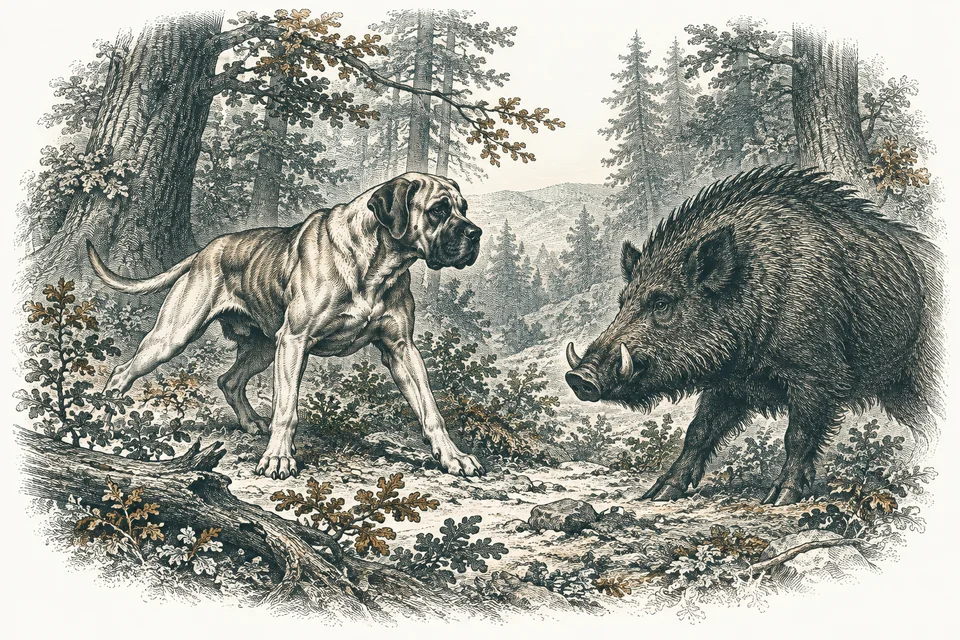
16th century or earlier
The boarhound
Big, fast, powerful dogs were used in the German principalities to hunt wild boar. The AKC describes the early dog as a mastiff type that took the form of a 'giant boarhound'.[22]
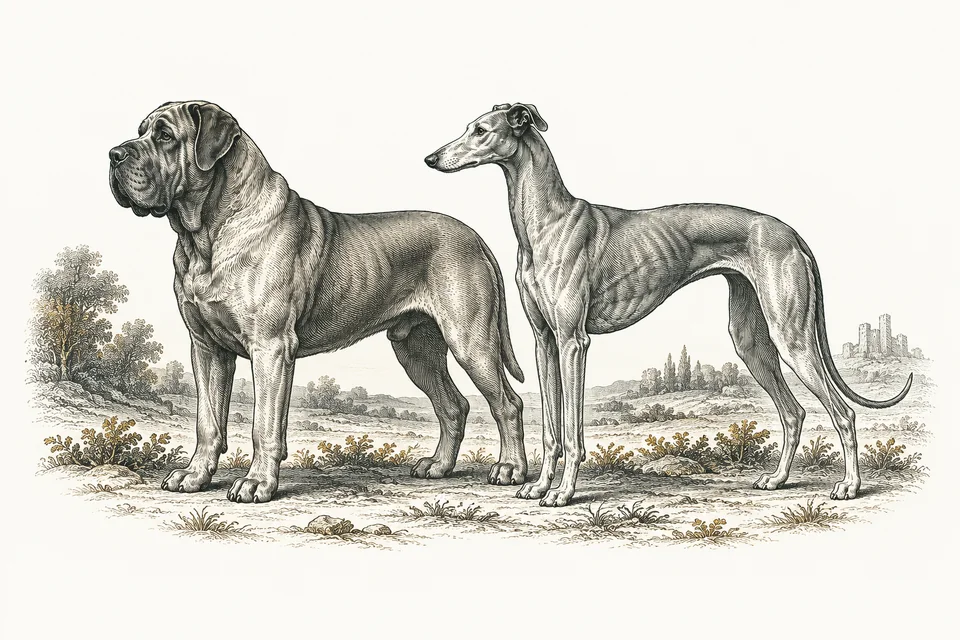
Ancestry
Mastiff strength, greyhound speed
The FCI traces the breed to the 'Bullenbeisser' (an old bulldog type) and to hunting and boar hounds that sat midway between the strong English-type mastiff and the fast Greyhound. The AKC adds that English breeders later crossed the somewhat coarse Danes with Greyhounds to refine them.[2,22]
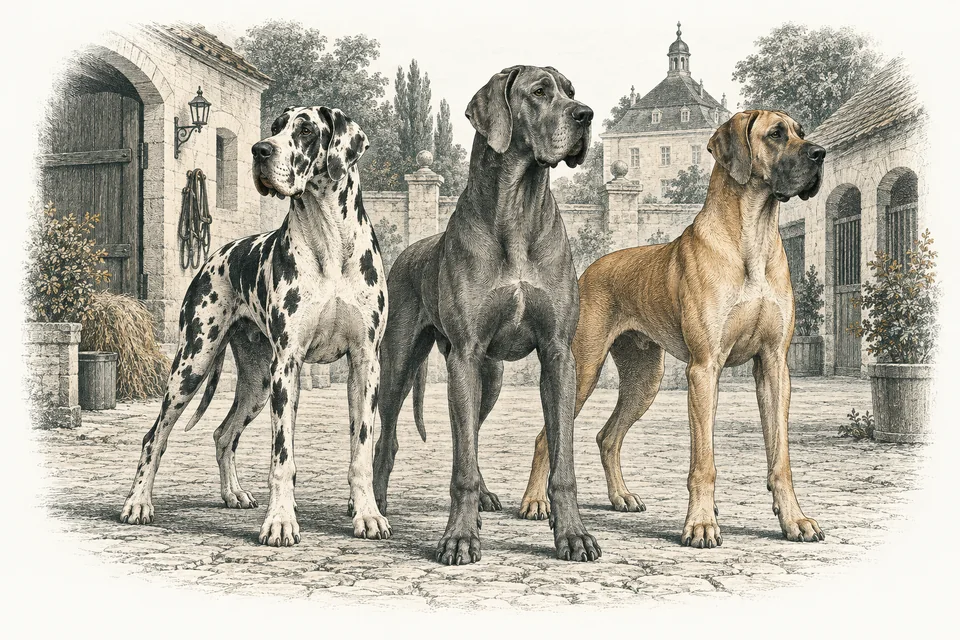
Mid-1800s
Many regional names
The same kind of dog went by names such as Ulmer Dogge, Englische (English) Dogge, Danish Dogge or Mastiff, Tigerdogge, Hatzrüde and Saupacker. The German club says black-and-white spotted dogs were bred mainly in the south, around Württemberg, while northern breeders favoured blue and fawn.[21,2]
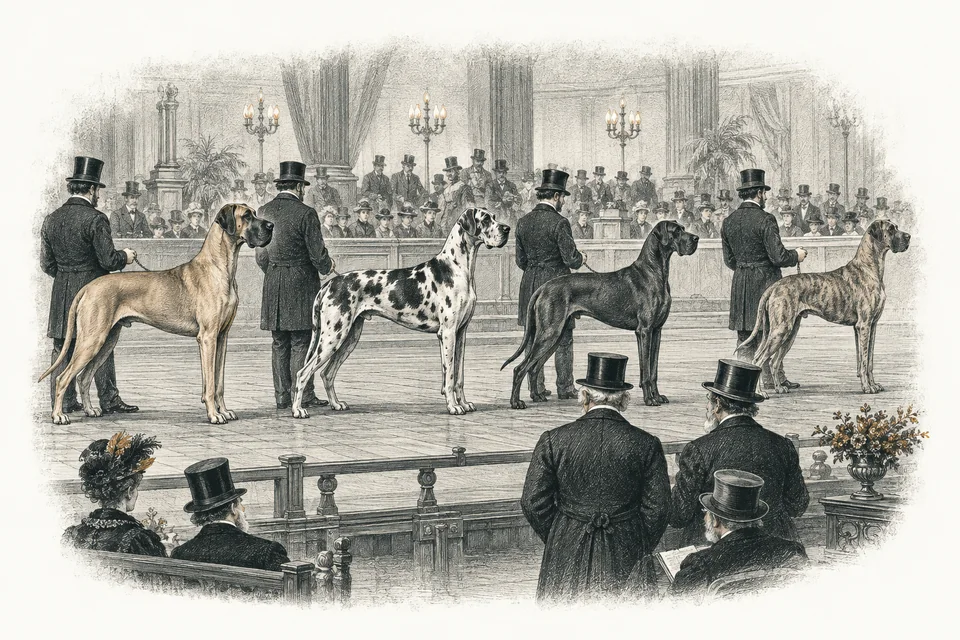
1876–1880
One breed: the Deutsche Dogge
In 1876 a group of judges declared that the regional types were one breed, though shows in Hamburg and Hanover kept them apart for a few more years. In Berlin, breeders and judges then adopted the single name 'Deutsche Dogge' and laid down the first standard. Sources give different years for these steps: the FCI says the name was agreed in 1878 and the standard in 1880, the German club says the name was fixed in 1880, and the AKC gives 1876 for the national breed and 1881 for the standard.[21,2,22]
The name
Why 'Great Dane'?
The German breed club says there is no sign that Denmark had any special part in creating the breed. In French the dog is the 'Grand Danois' and in English the Great Dane, a name first used in print by the French naturalist Buffon, while Germany kept 'Deutsche Dogge'. Both the German club and the AKC say nobody knows why that name was chosen.[21,22]
Stance, gait and angulation in 3D
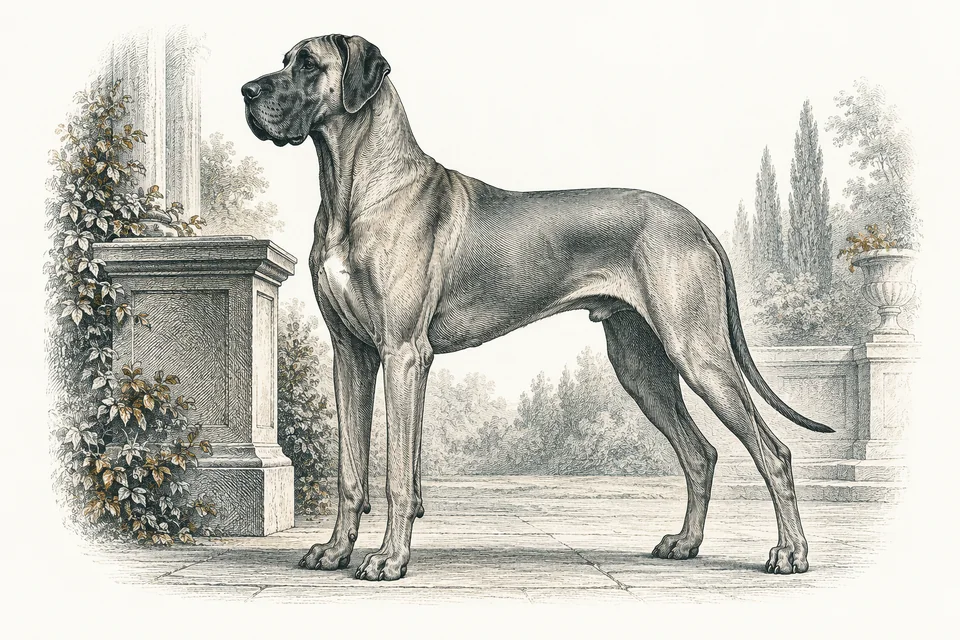
The lab's 'Stack' pose shows the show stance: head high on an arched neck, forelegs vertical, hind feet set back. Use it to check what the standards describe, such as straight, vertical forearms and a short, near-vertical rear pastern. Choose 'Stack' in the lab's gait controls.[2]